Short answer: Google Drive usually wins on value and collaboration if you already live in Gmail, Docs, Sheets, and Slides. Dropbox usually wins on file syncing, large-file handling, and sharing files with people outside your organization. Neither is universally “better” — the right pick depends on how you actually work.
If you’re trying to decide between Dropbox and Google Drive, this guide breaks down pricing, storage, security, and real-world use cases so you can make the call with confidence — and if you’re moving from one to the other, what that migration actually involves.
Dropbox vs Google Drive: Quick Comparison
| Factor | Dropbox | Google Drive |
| Free storage | 2 GB | 15 GB (shared with Gmail and Photos) |
| Entry paid plan | Plus: 2 TB, $11.99/mo | Google One/AI plans start around $1.99–$4.99/mo for smaller tiers |
| Top personal storage | 3 TB (Professional) | Up to 5 TB (Google AI Pro tier) |
| Business entry plan | Standard: from $18/user/mo, 3-user minimum | Business Starter: $7/user/mo, 30 GB/user |
| Max file size | 2 TB per file | 5 TB per file |
| Daily upload cap | None published | 750 GB/day |
| Native collaboration | File sync, comments, Dropbox Paper | Real-time co-editing in Docs, Sheets, Slides |
| Best for | File-heavy, cross-platform workflows | Google Workspace users, document collaboration |
| Security | AES-256 at rest, TLS in transit, 2FA | AES-256 at rest, TLS in transit, 2FA |
| Free-tier usability | Limited (2 GB) | More usable out of the box (15 GB) |
Pricing and storage figures are current as of 2026 but change frequently — verify current numbers on Dropbox’s and Google’s official pricing pages before making a purchase decision.
Winner by Category
| Category | Better Fit | Why |
| Free storage | Google Drive | 15 GB vs. 2 GB free |
| Document collaboration | Google Drive | Real-time co-editing in Docs, Sheets, Slides |
| File synchronization | Dropbox | Fast, reliable desktop sync across platforms |
| External file sharing | Dropbox | Password-protected, expiring links on lower-cost plans |
| Photo organization | Google Drive (via Google Photos) | Dedicated photo app with search and albums |
| Largest single-file size | Google Drive | 5 TB vs. 2 TB per file |
| No daily upload cap | Dropbox | Google Drive limits uploads to 750 GB/day |
| All-in-one productivity suite | Google Drive (via Workspace) | Bundles email, meetings, and docs |
| Cross-platform, file-centric workflows | Dropbox | Not tied to a single ecosystem |
Dropbox vs Google Drive: Which Is Better?
There’s no single winner — it depends on your workflow.
Google Drive has the edge if:
- You already use Gmail, Google Workspace, or Android devices
- Your team collaborates in real time inside Docs, Sheets, or Slides
- You want the most free storage without paying anything
- You want the largest single-file upload ceiling
Dropbox has the edge if:
- You work across many different apps and operating systems, not just Google’s ecosystem
- You regularly share files with clients or partners outside your organization
- You need granular link controls (passwords, expiration dates, download limits) on lower-cost plans
- Your workflow is centered on folders and files rather than live document editing
In short: people choose Dropbox over Google Drive when file syncing, folder-based workflows, and external file sharing matter more than having an integrated productivity suite. People choose Google Drive over Dropbox when document collaboration, ecosystem integration, and free-tier value matter more than standalone file sync.
Neither preference is “wrong” — they reflect different priorities, not different quality levels.
Dropbox vs Google Drive Pricing
Dropbox pricing
- Basic (free): 2 GB storage, access on up to 3 devices, 30-day version history
- Plus: 2 TB storage, roughly $11.99/month billed monthly (lower with annual billing)
- Professional: 3 TB storage, roughly $19.99/month billed monthly, adds advanced sharing controls and extended version history
- Family: 2 TB of storage pooled across up to 6 people, around $16.99/month
- Standard (Business): Starts around $18/user/month billed annually, requires a 3-user minimum, pooled team storage
- Advanced (Business): Higher per-user cost, more storage and admin/security controls
- Enterprise: Custom pricing based on team size and requirements
Google Drive / Google One pricing
Google’s free Drive storage is 15 GB, shared across Gmail, Google Photos, and Google Drive. Beyond that, Google has been actively restructuring its personal storage plans — historically branded “Google One,” and increasingly bundled with Gemini AI features under names like Google AI Plus and Google AI Pro. Entry-level paid storage tiers (around 100–200 GB) start at just a few dollars a month, while the top consumer tiers bundle several terabytes of storage with expanded AI features for around $20/month.
Because Google has changed these plan names, storage allocations, and prices more than once recently, treat any specific personal-tier numbers as a starting point and confirm current details at one.google.com/about/plans before publishing pricing in client-facing material.
Google Workspace (business) pricing is more stable:
- Business Starter: $7/user/month, 30 GB pooled storage per user
- Business Standard: $14/user/month, 2 TB pooled storage per user
- Business Plus: $22/user/month, 5 TB pooled storage per user
- Enterprise: Custom pricing, no user cap
For most small businesses, Google Workspace Business Standard and Dropbox Standard land in a similar price range — but Google Workspace bundles email, video conferencing, and productivity apps, while Dropbox Standard is focused specifically on file storage, sync, and sharing.
Storage and File Limits
Both services can handle large libraries, but they draw the line differently.
- Dropbox: Maximum file size is 2 TB. There’s no published daily upload cap, but uploads over roughly 375 GB through a web browser may time out — the desktop app or API is more reliable for very large files.
- Google Drive: Maximum file size is 5 TB, but Google enforces a 750 GB per day upload limit across My Drive and shared drives. Once you hit that limit, uploads pause until it resets 24 hours later.
If your workflow involves occasional very large files (raw video masters, large backup archives, database exports), Dropbox’s lack of a daily cap can be more convenient. If you’re uploading a single massive file, Google Drive’s higher per-file ceiling gives you more headroom.
File Sync and Speed
Both platforms sync reliably for most users, but they’re built differently.
Dropbox’s desktop sync engine (block-level sync, LAN sync, and selective sync) is widely regarded as fast and dependable, especially for large folders with lots of small file changes. Google Drive’s desktop app (Google Drive for desktop) supports streaming and mirroring modes and has improved significantly in recent years, but it’s more tightly coupled to Google’s broader ecosystem.
Real-world speed depends heavily on your internet connection, device, file size, and how many files are changing at once — so avoid treating either platform as universally “faster.” If sync performance is a dealbreaker, test both with your actual files before committing to a paid plan.
File Sharing and Collaboration
This is where the two platforms diverge the most.
Google Drive is built around real-time collaboration. Multiple people can co-edit a Doc, Sheet, or Slide simultaneously, with built-in comments, suggestions, and version history. Sharing permissions (viewer, commenter, editor) are simple to manage at the file or folder level.
Dropbox is built around file sync and sharing rather than live co-authoring. It offers shared links with optional passwords, expiration dates, and download limits (features that require a paid plan), version history, and Dropbox Paper for lightweight collaborative notes. Comments can be added directly on files.
If your team lives inside Google Docs and Sheets, Google Drive’s collaboration tools are hard to beat. If you’re sharing large files with people outside your organization who don’t use Google Workspace, Dropbox’s link controls are often more flexible.
Dropbox vs Google Drive for Photos
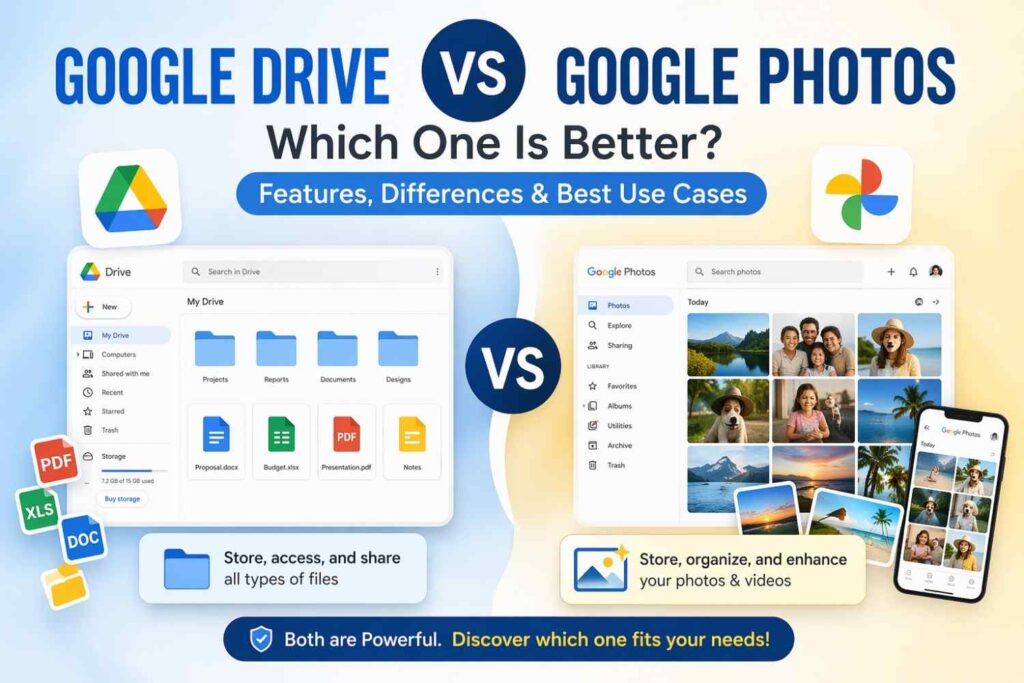
Google Drive has a natural advantage for photo-heavy users because it connects directly to Google Photos, which offers dedicated photo organization, facial recognition, search by content, and album sharing. Photos backed up through Google Photos and stored in Drive count against the same shared storage pool.
Dropbox doesn’t have an equivalent dedicated photo app, but it does offer camera uploads, basic thumbnail previews, and simple folder-based organization — which some professional photographers actually prefer, since it avoids algorithmic sorting and keeps folder structures exactly as created.
Bottom line: casual users and families often prefer Google Photos’ organization and search. Photographers who want full control over folder structure and file naming may prefer Dropbox’s straightforward approach.
Dropbox vs Google Drive for Videos
Neither service is a dedicated video-hosting platform — don’t expect YouTube-style playback, transcoding, or streaming optimization from either.
For raw video files, Dropbox’s higher single-file ceiling (2 TB) combined with no daily upload cap can be convenient for video editors syncing large project files. Google Drive supports files up to 5 TB but caps daily uploads at 750 GB, which can slow down teams uploading multiple large video files in the same day.
For collaborative video review, tools built specifically for that purpose (rather than general-purpose cloud storage) will usually outperform either platform.
Security and Privacy
Both platforms use industry-standard protections: AES-256 encryption for data at rest, TLS/SSL encryption for data in transit, and two-factor authentication (2FA) support on personal and business accounts.
Is Google Drive safer than Dropbox? Neither is clearly safer for every user. Both use strong encryption and account-security protections; where they differ is in their advanced security and administration features, which vary by plan:
- Google Drive integrates with Google Workspace’s broader security tools — data loss prevention (DLP), audit logs, and admin-level threat detection on business plans.
- Dropbox offers advanced sharing controls (password-protected and expiring links, download limits), ransomware detection and alerts, and remote wipe on business plans.
- Both providers support compliance frameworks like GDPR, and both offer HIPAA-eligible configurations on qualifying business plans.
In practice, account security depends more on your own habits — using 2FA, strong unique passwords, and reviewing sharing permissions regularly — than on which provider you choose. Is Dropbox safe? Yes, when configured correctly and paired with 2FA, same as Google Drive.
Dropbox vs Google Drive for Small Business
This is often the deciding factor for SMBs comparing the two.
| Consideration | Dropbox | Google Drive (via Google Workspace) |
| Entry price | $18/user/mo (3-user minimum) | $7/user/mo (no minimum) |
| What’s included | File storage, sync, sharing | Email, video meetings, Docs/Sheets/Slides, storage |
| Admin controls | Available on business tiers | Available on all business tiers |
| Best fit | Teams needing robust file sync/sharing across mixed tools | Teams wanting an all-in-one productivity suite |
If you need business email, video conferencing, and document collaboration in one subscription, Google Workspace tends to deliver more value per dollar, since the price covers far more than storage alone. If your team already has email and productivity tools elsewhere and specifically needs reliable file sync and sharing without paying for a full productivity suite, Dropbox Business plans are purpose-built for that instead.
Dropbox vs Google Drive: Pros and Cons
Dropbox
Pros: strong desktop sync performance, flexible link-sharing controls, works equally well across Windows, Mac, iOS, Android, and Linux, no daily upload cap.
Cons: smallest free tier among major providers (2 GB), business plans require a 3-user minimum, fewer built-in collaboration/productivity tools than Google Workspace.
Google Drive
Pros: generous free tier (15 GB), tightly integrated real-time collaboration, strong value when bundled with Google Workspace, largest single-file size limit.
Cons: 750 GB daily upload cap can slow down bulk uploads, storage is shared across Gmail and Photos on personal accounts (easy to fill up faster than expected), heavier reliance on the Google ecosystem for full functionality.
Dropbox vs Google Drive vs OneDrive
A quick note on the third major player: Microsoft OneDrive. If your organization already runs on Microsoft 365, OneDrive typically makes the most sense since it’s bundled with Word, Excel, Outlook, and Teams. Google Drive is the natural fit for Google Workspace users, and Dropbox tends to appeal to teams and individuals who prioritize file sync and sharing over a specific productivity ecosystem. If you’re weighing all three, the deciding factor usually comes down to which ecosystem — Google, Microsoft, or neither — your team already relies on day to day.
Dropbox vs Google Drive: Which One Should You Choose?
Choose Google Drive if:
- You already use Gmail or Google Workspace
- Your team collaborates heavily in Docs, Sheets, and Slides
- You want the most storage for the least cost, especially bundled with productivity tools
- You want simple integration with Android and Chrome
Choose Dropbox if:
- File synchronization and sharing are your primary need
- Your workflow is file- and folder-centric rather than document-collaboration-centric
- You regularly collaborate with people outside your organization’s ecosystem
- You need flexible link controls without upgrading to a full productivity suite
Should You Switch From Dropbox to Google Drive?
If you’re already on Dropbox, switching isn’t always necessary — but it can make sense in specific situations.
Switching may be worth it if:
- Your team has already standardized on Gmail or Google Workspace for email and communication
- You need tighter integration with Docs, Sheets, and Slides for daily collaboration
- You want to consolidate email, storage, and productivity tools under one subscription
Switching may not be worth it if:
- Your existing Dropbox folder structure and sharing links are deeply embedded in client-facing workflows
- Your team relies on cross-platform desktop sync more than live document co-editing
- You don’t currently use — or plan to use — Google Workspace
If you do decide to move, the practical challenge isn’t deciding to switch — it’s actually transferring years of files, folder structures, and sharing permissions without breaking anything along the way. For large Dropbox libraries, a managed migration can be considerably easier than downloading and re-uploading everything manually, especially when folder structure, permissions, and minimizing downtime all matter. That’s the kind of transfer SkyMigrate’s migration services are built to handle.
Frequently Asked Questions
Is Google Drive better than Dropbox? Neither is universally better. Google Drive tends to offer more value for document collaboration and Google Workspace users; Dropbox tends to offer more flexibility for file-centric, cross-platform workflows.
Is Dropbox still worth using? Yes — but the better question is whether its workflow fits your needs, not just whether it’s still popular. Dropbox competes with Google Drive differently rather than head-on: it’s strongest for file-centric, cross-platform, and client-facing sharing workflows, not for real-time document collaboration. Choose it because that fits how you work, not simply because it’s a familiar name.
Is Dropbox in decline? Dropbox faces strong competition from Google Drive, OneDrive, iCloud, and other cloud storage providers, but competition alone doesn’t mean a service is obsolete. The more useful question for most readers is whether Dropbox’s file-sync and sharing features fit their workflow — not its market share. If you need current customer or revenue figures for research purposes, verify those against Dropbox’s own investor communications rather than relying on secondhand claims.
Is Dropbox safer than Google Drive? Both use comparable encryption (AES-256 at rest, TLS in transit) and support two-factor authentication. Neither has a meaningful security advantage over the other — account security depends more on how you configure and use each service.
Do I need Dropbox if I already have Google Drive? Not necessarily. Many users run only one cloud storage service. You might use both if your organization needs Google Workspace for collaboration but also needs Dropbox-specific sharing controls for external file delivery.
What is the biggest disadvantage of Google Drive? The 750 GB daily upload cap and the fact that personal storage is shared across Gmail, Photos, and Drive, which can fill up faster than users expect.
What is the biggest disadvantage of Dropbox? The free tier is limited to 2 GB, and business plans require a minimum of 3 users, which can be restrictive for very small teams or solo users needing admin features.
Can I move my Dropbox files to Google Drive? Yes. Files can be moved manually by downloading from Dropbox and uploading to Google Drive, or through a managed migration service for larger libraries where preserving folder structure, permissions, and minimizing downtime matters.
Conclusion
Dropbox and Google Drive both do the core job — storing and syncing your files in the cloud — but they’re built around different priorities. Google Drive is the stronger choice for teams already inside the Google ecosystem who want real-time document collaboration and strong value. Dropbox is the stronger choice for file-heavy, cross-platform workflows where flexible sharing controls and dependable sync matter more than co-authoring documents.
Whichever platform fits your workflow better, the decision doesn’t have to be permanent — and if you do decide to move your files from one to the other, planning the migration carefully will save you far more time than the switch itself.